

FLARE GUN
High-poly modeling is often a time-consuming process, but for this asset I used a new procedural approach in Blender that significantly speeds it up. By applying a set of built-in modifiers to a low-poly base mesh, I was able to quickly generate a high-poly version without traditional manual sculpting. This method greatly reduces production time while maintaining high surface quality.
Gun in action
Unreal Engine viewport screenshot (Lumen)
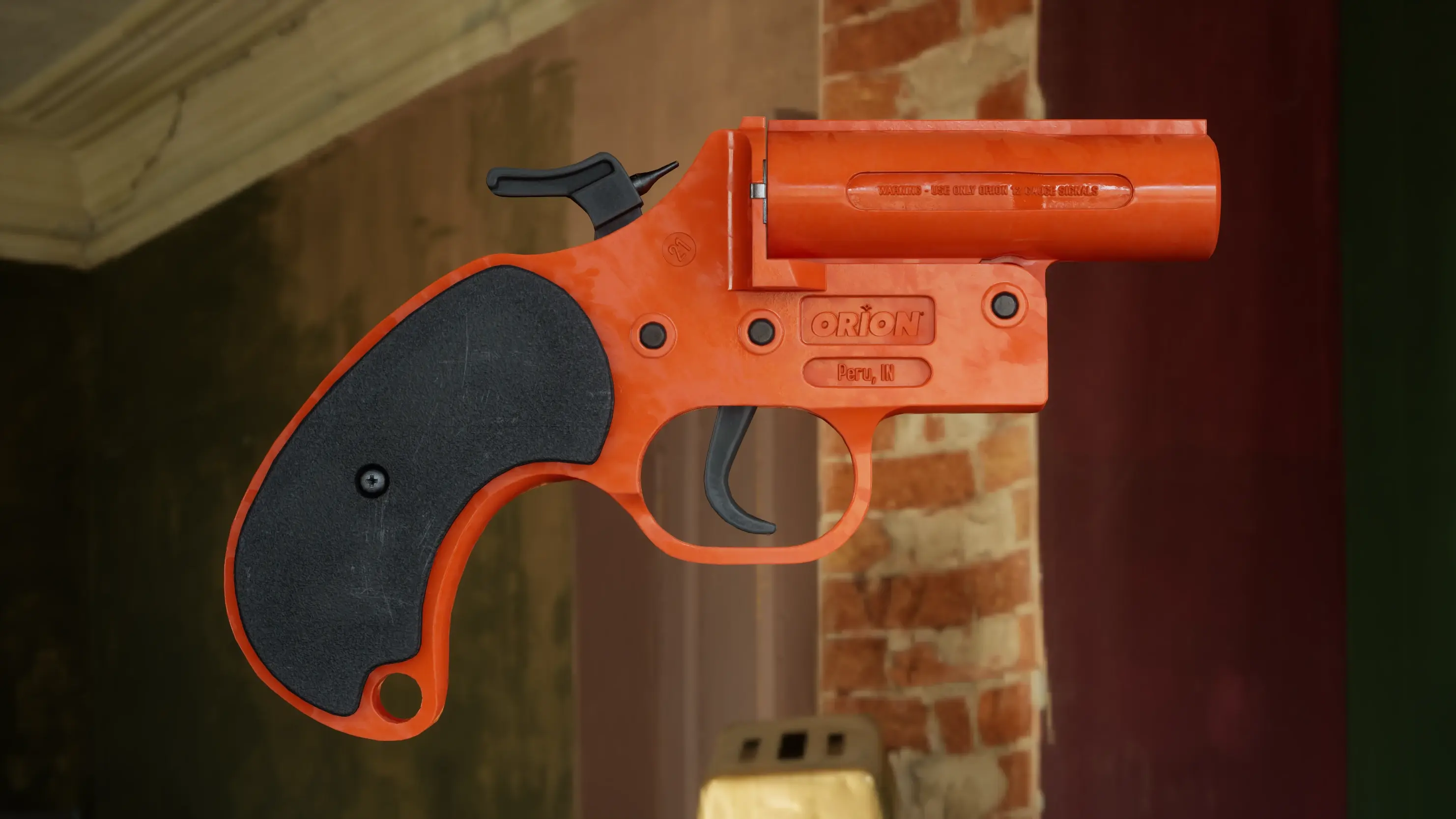
Model in-action inside Unreal Engine (implemented in self-written "inspection" and "equip" systems):
~ BREAKDOWN SECTION ~
As always, the process began with a thorough study of the gun — collecting references, searching for technical documentation, and gathering dimensional data to ensure accuracy. My reference board is attached below.

Doing the modeI, I focused on maximum topology optimization with minimal reliance on bevels. For this I developed a custom procedural workflow for generating high-poly geometry using a sequence of modifiers (Subdivision → Remesh → Smooth). These were applied to a primitive version of the low-poly mesh to quickly generate detailed high-poly geometry. Then I performed manual retopology on the generated high-poly mesh, carefully preserving surface curvature to produce a clean, optimized low-poly version suitable for baking and real-time use.
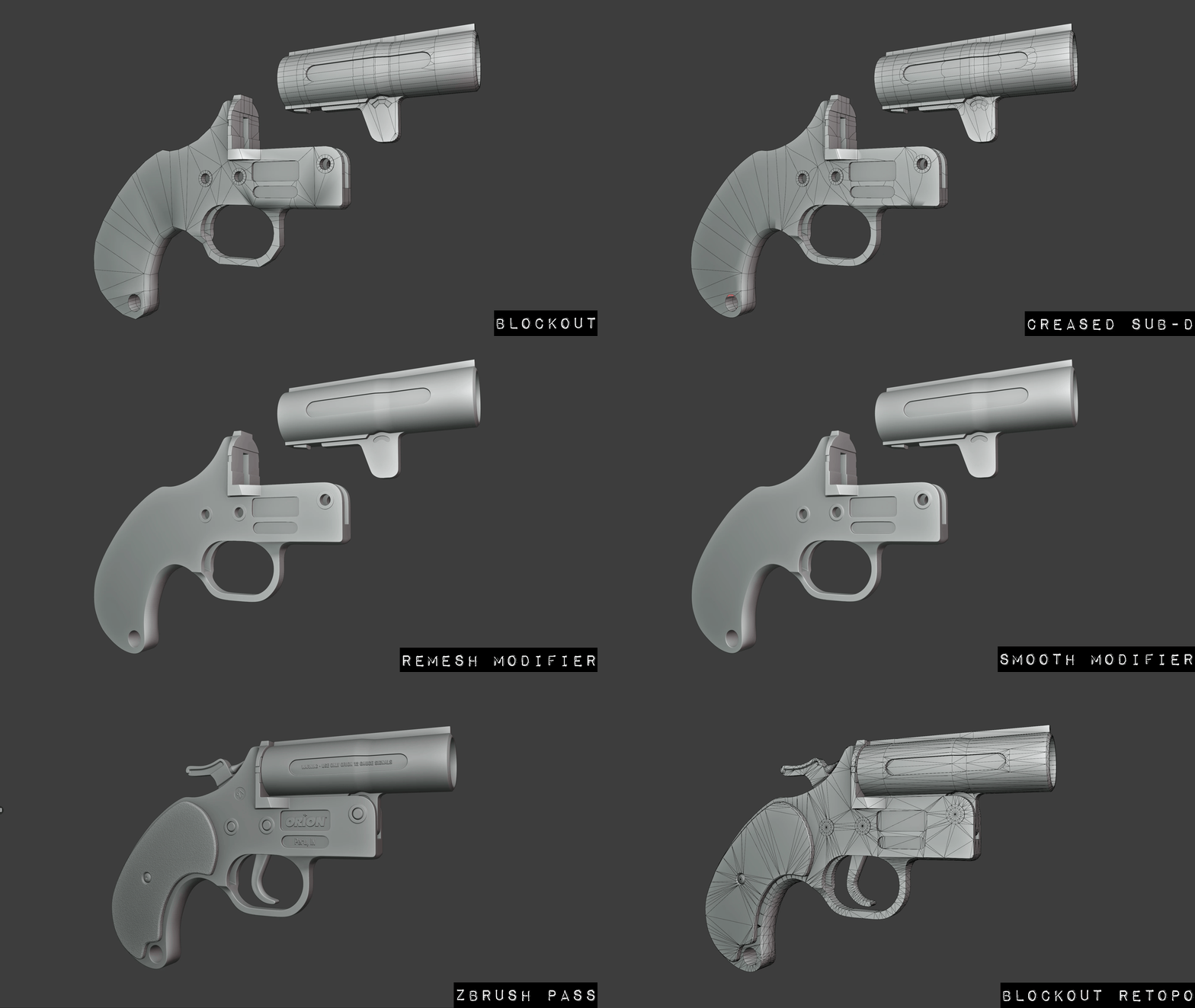
That's the high-poly models I've got after applying modifiers (folds on the bullet and text on the gun were added in ZBrush using alphas I made in PS).
To achieve even artifact-free bake, the model was grouped by logical parts for individual baking inside Marmoset:
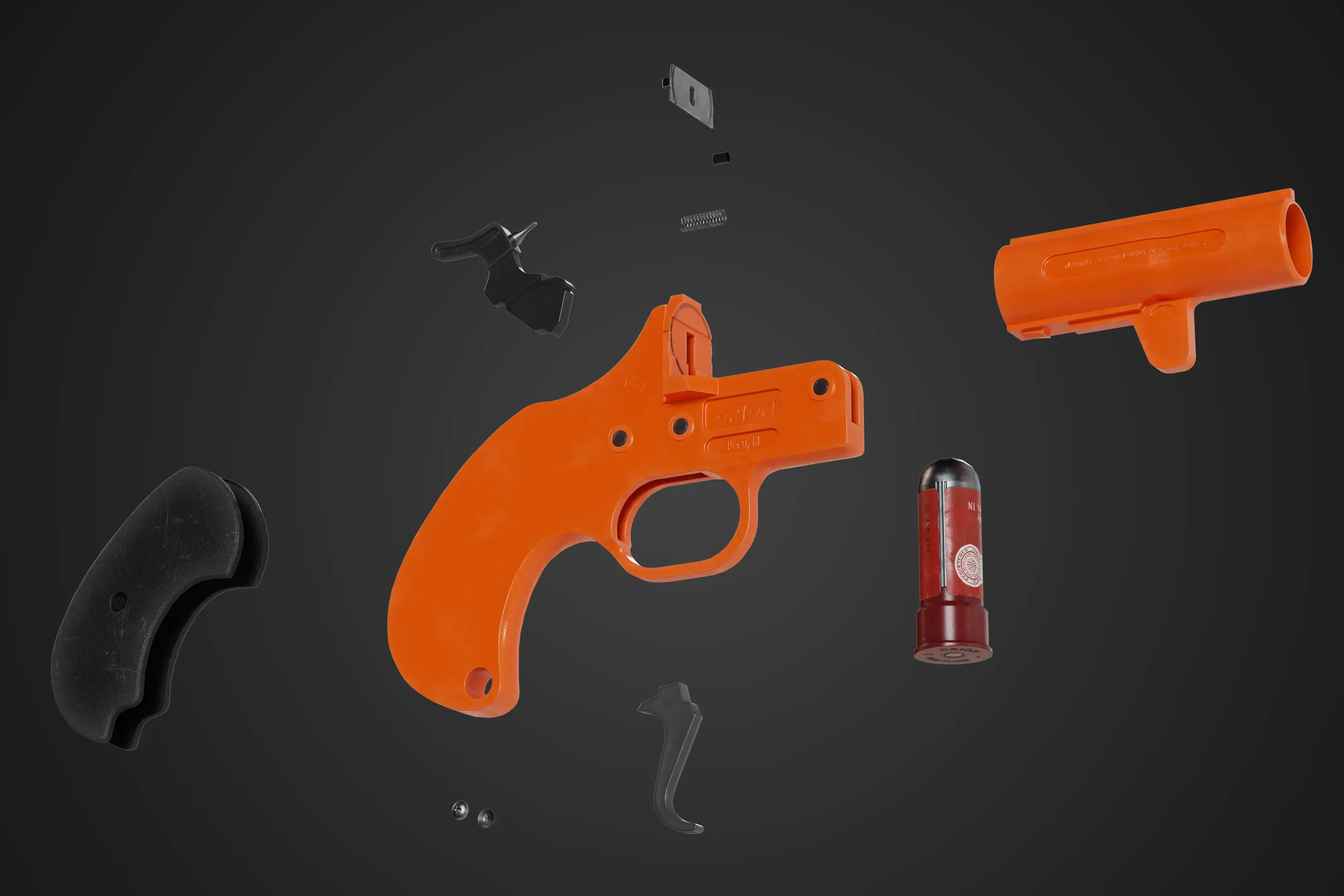
The texturing process remained largely the same as in my previous workflows. The only notable addition was the use of Subsurface Scattering (SSS) which was based on a pre-baked thickness map, to better capture the semi-transparency and light diffusion of plastic materials, adding a more realistic look to the surface.
Marmoset viewport
~ OPTIMISATION SECTION ~
For such a weapon object in a first-person game, it's optimal to aim for 10.24-20.48px/cm. So by grouping some of the UV-islands during the unwrapping process, I managed to achieve 14 px/cm for the weapon (for 1K texture). The cartridge for the weapon, is mapped to its own low-resolution texture map (256px) with approximately the same texel size.
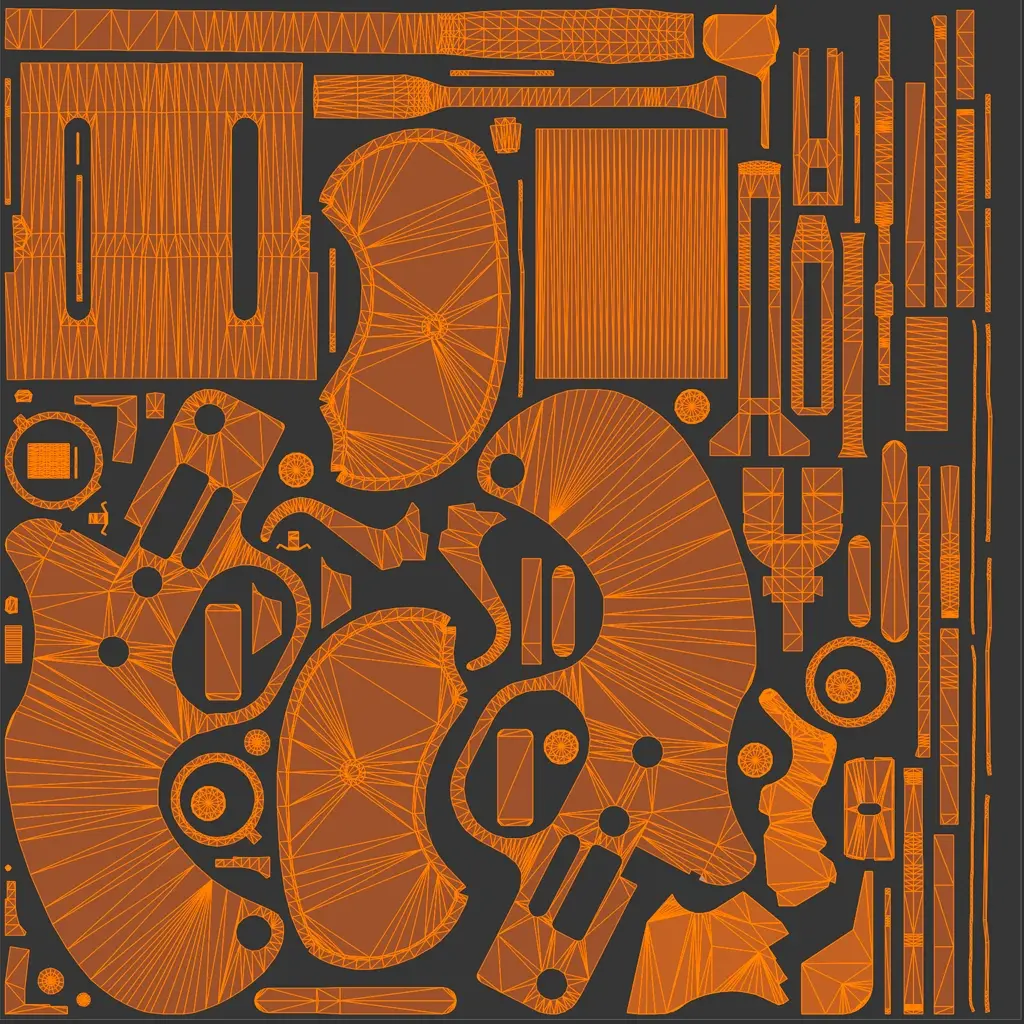
GUN: 14 px/cm, 1K texture, 65% UV utilization (6,3K tris)
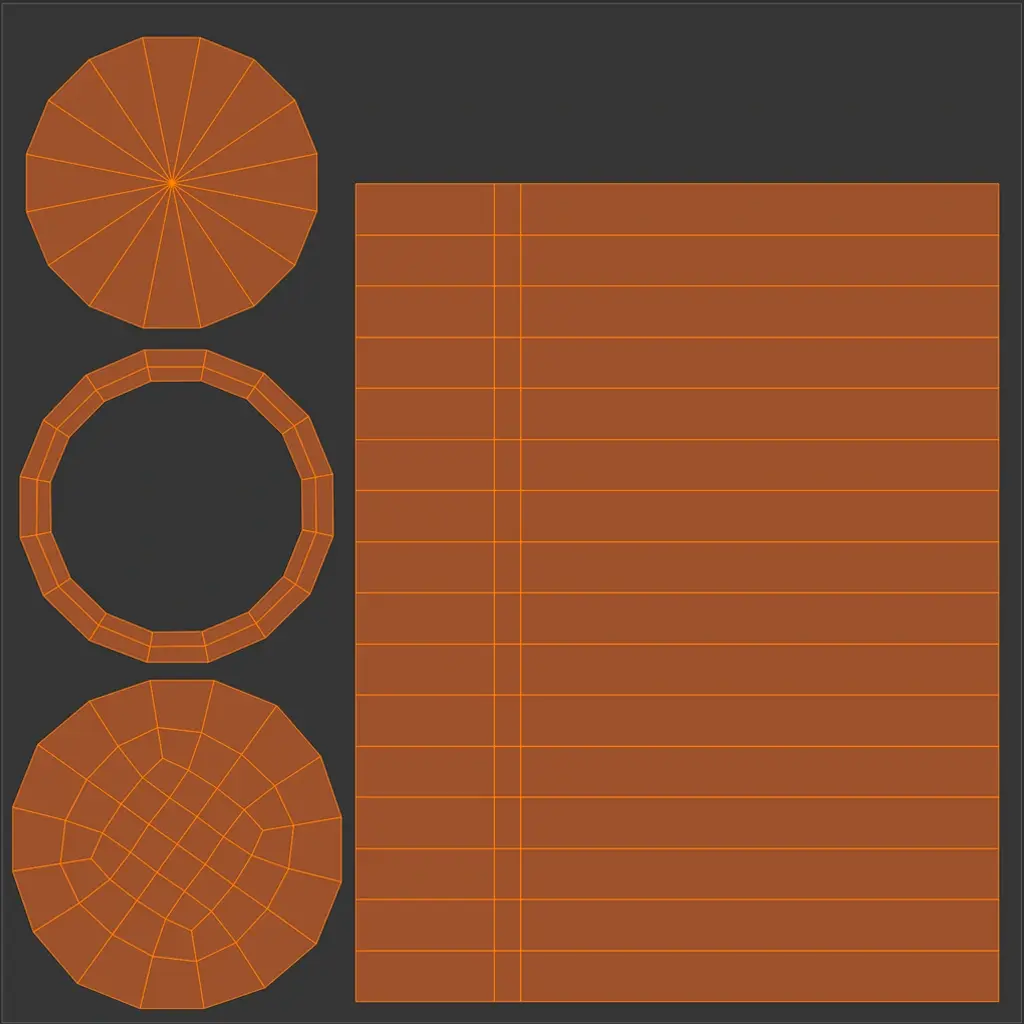
PROJECTILE: 13 px/cm, 256px texture, 68% UV utilization (272 tris)
Render of an optimized, game-ready model (1k and 256px textures)
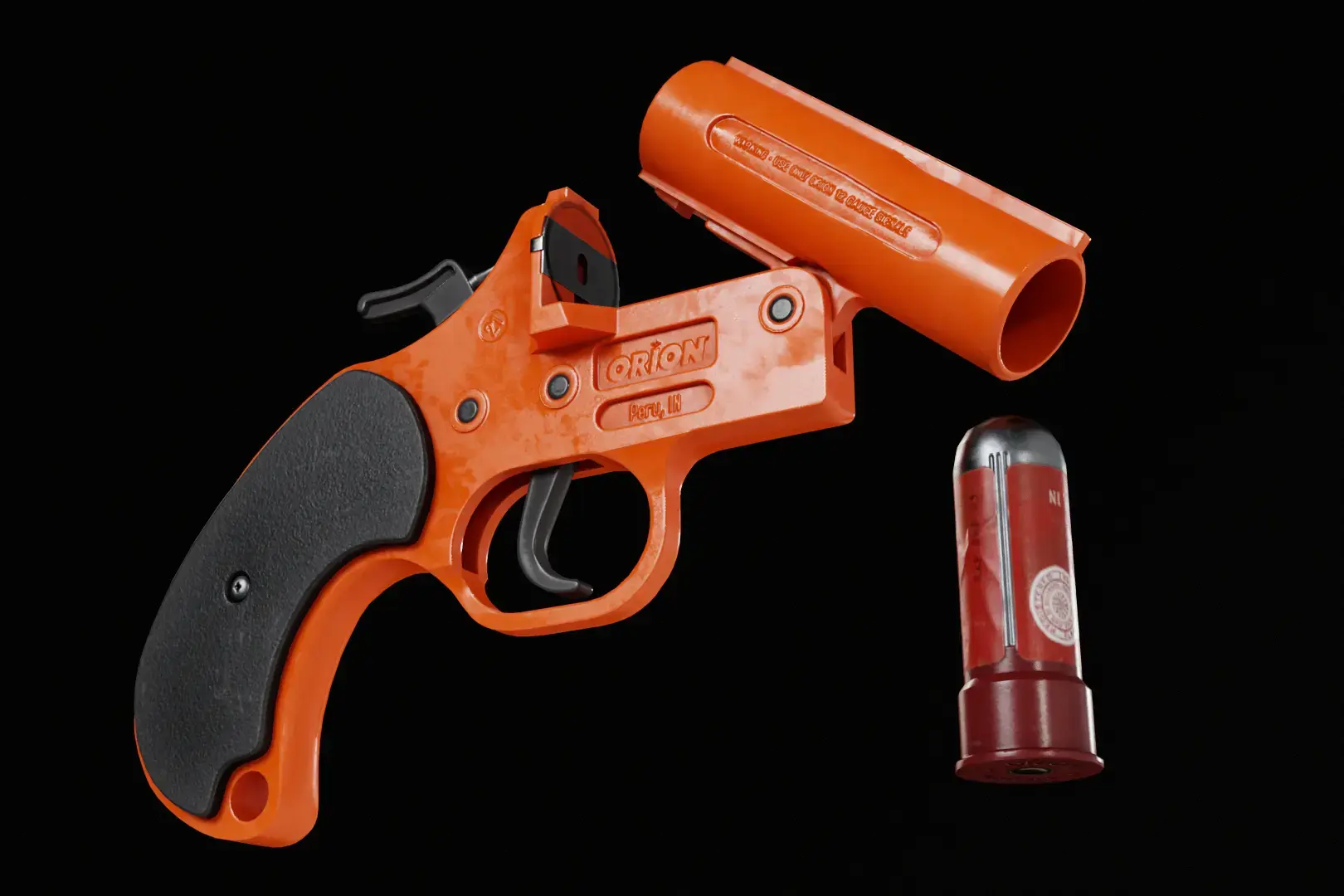
By using this procedural high-poly workflow, I was able to reduce the overall modeling time by approximately one-third. The final result is a highly optimized 6K poly model, achieved without excessive use of bevels to sell the curvature — thanks to smart topology planning and silhouette-aware retopology.
Here you can see the model and textured details up close


